RSS

Thanksgiving Recipes For Turkey, Vegetables, Sides, Cocktails And Crucial Closers | Food Republic

Thanksgiving Recipes For Turkey, Vegetables, Sides, Cocktails And Crucial Closers | Food Republic.

Food Republic takes the time to get together some of their best recipes for your Thanksgiving meal. They have a little bit of everything here so you are bound to find some ideas and inspiration for just what you need to make your meal great. Check it out!

 
Leave a comment

Posted by on November 25, 2013 in Cooking, Cooking Websites, Holidays


Tags: , , ,

One More Easy Turkey Recipe Before Thanksgiving – Simple Roast Turkey

Okay, there is still plenty of time left if you haven’t really decided want you want to do with your turkey on Thanksgiving. It’s only Monday, so you still have time to do some kind of brining if that is what you want to do. I made another turkey this past weekend to try out a dry brine method that I saw from The New York Times and Melissa Clark recently because I wanted to see if it made any difference in the bird. If it seems like I have made a lot of  turkey the last few weeks, well I have. I wanted to try some things out to give people some options and see how things work and since I wasn’t cooking Thanksgiving dinner this year myself, it seemed like a good idea. I even have 1 turkey left to cook, but my family is getting kind of tired of eating turkey at this point so I might hold on to that one until we get closer to Christmas. In the meantime, here is a very simple dry brine recipe that adds some great flavor to the turkey.

Simple Roast Turkey

1 turkey, 10 to 12 pounds

Coarse kosher salt

1 tablespoon black pepper

1 lemon, zested and quartered

1 bunch fresh thyme or rosemary

1 bunch fresh sage

12 garlic cloves, smashed and peeled

1 bottle hard cider (12 ounces)

Dry white wine or water, as needed

2 onions, peeled and quartered

3 bay leaves

Olive oil or melted butter, as needed

Remove any giblets from the cavity and reserve for stock or gravy. Pat the turkey and the turkey neck dry with paper towels; rub the turkey all over with 1/2 teaspoon of kosher salt per 1 pound of turkey, the pepper and the lemon zest, including the neck. Transfer the turkey to a 2-gallon or larger resealable plastic bag. Tuck the herbs and 6 garlic cloves inside the bag. Seal and refrigerate the turkey on a small baking sheet or wrapped in another plastic bag for at least 1 day and up to 3 days, turning the bird over every day or after 12 hours if brining for only 1 day.

Remove the turkey from the bag and pat it dry with paper towels. Place the turkey, uncovered, back on the baking sheet. Return it to the refrigerator for at least 4 hours and up to 12 hours to dry out the skin. This will help to crisp the skin while it is cooking.

When you are ready to cook the turkey, remove it from the refrigerator and allow it to come to room temperature for one hour.

Heat the oven to 450 degrees. In the bottom of a large roasting pan, add the hard cider and enough wine or water to fill the pan to 1/4-inch depth. Add half of the onions, the remaining 6 garlic cloves and the bay leaves. Stuff the remaining onions and the lemon quarters into the turkey cavity. Brush the turkey generously with olive oil or melted butter.

Place the turkey, breast side up, on a roasting rack set inside the roasting pan. Transfer the pan to the oven and roast for 30 minutes. Cover the breast with aluminum foil. Reduce the oven temperature to 350 degrees and continue roasting until an instant-read thermometer inserted into the thickest part of a thigh registers 165 degrees, about 1 1/2 to 2 hours more. Transfer the turkey to a cutting board to rest for at least 30 minutes before carving.

A couple of things about roasting turkey. Though you have probably heard it a thousand times by now from every cooking show, magazine and blog out there, brining isn’t a necessity when cooking turkey; it does seem to help as far as flavor and the skin itself, but the only real key to having moist turkey is removing the turkey from the oven when it is the right temperature. Don’t go by those little buttons that pop up on the turkey; they are often set to pop when the internal temperature is already high, sometimes 180 degrees, and the bird will continue to cook as it rests outside the oven, leaving you with dry turkey. Invest the money in a thermometer and insert it into the thigh to check the temperature. When it is at 165, pull the turkey out and LET IT REST. Don’t carve it right away; it won’t be ready, you’ll lose all the liquid that needs to re-distribute while the bird rests, and you will end up with dry meat.

If you don’t have a roasting rack to put the turkey on, you can make something of your own to get the turkey up out of the liquid so it browns all over. Form a solid ring out of aluminum foil to place under the turkey to lift it out of the liquid. That is what I did with this bird since I wanted to use one of those disposable pans this time and my rack did not fit in the pan. It worked out really well and it is easy to do.

The dry brine in this recipe really seemed to add some flavor and I did like the combination of the cider and the aromatics. It helped to create some very tasty gravy for the meal. This is one of the easiest turkey recipes I have come across and one of the most effective. If you are making a larger bird, the New York Times does have a scale so you can adjust the herbs and seasonings and cooking time of your bird accordingly. You can check it out here if you wish. I would use this recipe if you want to do things easily for yourself and have great tasting turkey.

That’s all I have for today. I still have a couple of more side dishes to share before Thanksgiving, so check back for those. Until next time, enjoy the rest of your day and enjoy your meal!

IMG_1759

 
1 Comment

Posted by on November 25, 2013 in Cooking, Dinner, Holidays, Poultry, Turkey


Tags: , , , , , ,

A Throwback Dessert for the Holidays: Pineapple Upside-Down Cake

Pineapple upside-down cake is not something I would think of making very often. Let’s be honest – most of us who are old enough probably associate it with seeing it at parties our parents had when we were growing up in the seventies. You may not even have a good memory of it thanks to the tinny taste of the pineapple from the can and the super-sweet juice that came with it. All of that being said, Michelle had said to me not the long ago that she might want to give the dessert a try. As fate would have, when I walked into the grocery store last week fresh pineapples were on sale. I bought one and set about finding a recipe, and this one from Cook’s Illustrated seemed to be the best to use and the easiest to make.

Pineapple Upside-Down Cake

Pineapple Topping:

1 medium fresh pineapple (about 4 pounds), peeled, cored and cut into 1/2-inch pieces

1 cup firmly packed light brown sugar

3 tablespoons butter

1/2 teaspoon vanilla extract

Cake:

1 1/2 cups all-purpose flour

1 1/2 teaspoons baking powder

1/2 teaspoon salt

8 tablespoons butter, softened but still cool

3/4 cup granulated sugar

1 teaspoon vanilla extract

2 eggs at room temperature

1 egg white at room temperature

1/3 cup milk at room temperature

Lightly spray a 9-inch round cake pan with nonstick cooking spray and set it aside.

For the pineapple topping, combine the pineapple and brown sugar in a large skillet and cook over medium heat, stirring occasionally during the first five minutes until the pineapple is translucent and has a light brown hue, about 15 to 18 minutes. Empty the fruit and the juices into a mesh strainer or colander set over a medium bowl. Return the juices to the skillet, leaving the pineapple in the strainer. You should have about 2 cups of cooked fruit. Simmer the juices over medium heat until it is thickened and beginning to darken and the mixture forms large bubbles, about 6 to 8 minutes, adding any more juices released by the fruit to the skillet after about 4 minutes. Off the heat, whisk in the butter and the vanilla. Pour the caramel mixture into the prepared cake pan. Set it aside while preparing the cake batter.

For the cake, adjust an oven rack to the lower-middle position and heat the oven to 350 degrees. Whisk the flour, baking powder and salt in a medium bowl and set it aside.

In the bowl of a standing mixer fitted with a flat beater, cream the butter and the sugar at medium-high speed until it is light and fluffy, about 3 to 4 minutes. Reduce the speed to medium, add the vanilla and beat to combine. One at a time, add the whole eggs and then the egg white, beating well and scraping down the bowl after each addition. Reduce the speed to low; add about 1/3 of the flour mixture and beat until it is incorporated. Add half of the milk and beat until it is incorporated; repeat the process, adding half of the remaining flour mixture and the remaining milk, and finish with the remaining flour. Give a final stir with a rubber spatula, scraping the bottom and sides of the bowl to ensure that the batter is combined. The batter will be thick.

To bake the cake, working quickly, distribute the cooked pineapple in the cake pan in an even layer, gently pressing the fruit into the caramel. Using a rubber spatula, drop mounds of the batter over the fruit, then spread the batter over the fruit and to the sides of the pan. Tap the pan lightly against the work surface to release any air bubbles. Bake until the cake is golden brown and a toothpick inserted into the center comes out clean, about 45 to 50 minutes. Cool for 10 minutes on a wire rack, then place an inverted serving platter over the cake pan. Invert the cake pan and platter together and lift off the cake pan to release the cake. Cool the cake to room temperature for about 2 hours, then cut into pieces and serve.

Taking the time to peel, core and chop a fresh pineapple is very worth it for this recipe and makes all the difference. The fresh pineapple taste and smell, to me, is so much better than what you get from a can and preparing the pineapple only takes a few minutes. The rest of the recipe is very easy and produces great results. You get the nice caramelized pineapple with a light cake and it was much better than any of us remembered it. I actually did the whole recipe in my trusty cast iron skillet. I cooked the pineapple and the caramel in it, cooled the pan with the caramel, pressed in the pineapple and poured in the batter. I think it came out just as well as it would in a cake pan, saved me a little cleaning and came out of the pan just as easily as it would a cake pan.

That’s all I have for today. Check back next time for another recipe. I tried out a couple of more Thanksgiving recipes yesterday, so I will post those before the big day on Thursday. Until next time, enjoy the rest of your day and enjoy your meal!

001

 
1 Comment

Posted by on November 24, 2013 in Cakes, Cooking, Dessert


Tags: , , ,

You Gotta have Bread for Thanksgiving – Easy New Orleans French Bread and Focaccia Rolls

I have been branching out more and more into the world of bread and making my own at home when I can. It just plain tastes better and works out to be a lot cheaper than what you pay for it in the stores. While I do try to keep things simple with what a make, I just recently tried a couple of recipes that are easy to do, with few ingredients, and will go well not just with your holiday meal plans but are great for any time. The first I tried is New Orleans French bread from Saveur magazine.

New Orleans French Bread

2 tablespoons sugar

2 1/4-ounce packages active dry yeast

2 tablespoons vegetable shortening

6 cups bread flour

1 tablespoon kosher salt

Place 1 tablespoon of the sugar, the yeast and 2 cups of water heated to 115 degrees in the bowl of a stand mixer fitted with a dough hook; let the mixture sit until it is foamy, about 10 minutes. Add the remaining sugar and the shortening and then add the flour and salt. Mix on low-speed until the dough forms; increase the speed to medium-high and knead the dough until it is smooth, about 8 to 10 minutes. Remove the bowl from the mixer and cover it with plastic wrap. Let the dough sit until it has doubled in size, about 1 1/2 to 2 hours.

Uncover the dough and transfer it to a floured work surface. Knead the dough briefly to form a ball. Divide the dough into quarters and shape each quarter into a 16-inch long thick rope. Place two ropes each on a parchment paper-lined baking sheet and cover with plastic wrap. Allow the loaves to sit until they have doubled in size, about 1 to 1 1/2 hours.

Heat the oven to 375 degrees. Using a sharp knife or cutting blade, slash a long line down the center of each loaf. Bake the loaves until they are light brown and an instant read thermometer inserted into the center of each loaf reads between 208 to 212 degrees, about 30 minutes. Let the loaves cool for 15 minutes before serving.

Of course, we couldn’t resist and cut into one of the loaves right out of the oven and it was great. These French bread loaves are crunchy and delicious and perfect for many uses. Not only are they great to go with your entrée, but they would be great for appetizers like crostini, or just dipped in some olive oil. They are also ideal for sandwiches of all kinds. I’ll definitely make these again.

The other bread I tried this week is a simple recipe I came across for focaccia rolls. I wanted to make something that could be used for dinner rolls or also used for sandwiches and the like and this recipe was easy enough and seemed to fit my needs the best.

Focaccia Rolls

1 1/4 cups warm water (105 to 115 degrees)

1 teaspoon honey

1 tablespoon active dry yeast

1/4 cup olive oil, divided

2 teaspoons salt

1 1/2 teaspoons Italian seasoning, divided

3 1/2 cups bread flour

In the bowl of a stand mixer, stir together the warm water, honey and the yeast. Allow the mixture to proof until it id frothy, about 10 minutes. Add 2 tablespoons of the olive oil, the salt, 1 teaspoon of Italian seasoning and mix together.

In a small bowl, mix together the remaining olive oil and herbs and set aside.

Attach the dough hook to the mixer and add the flour to the mixture in the bowl. Knead the mixture on medium speed for 10 to 12 minutes until the dough is smooth and elastic and does not stick to your hands.

Oil a large bowl and add the dough. Cover the bowl with a damp towel or plastic wrap and place it in a draft-free area to rise for 1 1/2 to 2 hours or until the dough has doubled in size.

Once the dough is risen, punch it down and divide it into 12 equal size balls. Place the balls on a greased baking sheet, cover it with a damp towel and allow it to rise for 30 to 40 minutes.

Heat the oven to 400 degrees. Using the remaining olive oil and her mix, brush the top of each roll. Place the baking sheet in the oven and bake for 20 to 25 minutes, until the tops of the rolls are golden brown and the rolls sound hollow.

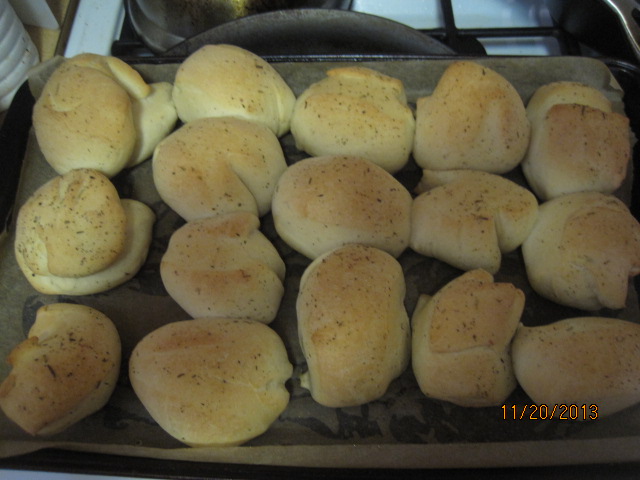
I actually got more than 12 rolls out of this batch as I made some smaller and some larger so we could use some for dinner rolls and some for hamburgers. They have great flavor to them and I really liked them with the burgers. The small ones are perfect as dinner rolls for your holiday meals. I’ll be making these again as well.

That’s all I have for today. Check back again next time for more recipes. I still have a few Thanksgiving ideas if you are looking for something, so stayed tuned. Until next time, enjoy the rest of your day and enjoy your meal!

IMG_0389 002 003 IMG_0388

 
Leave a comment

Posted by on November 23, 2013 in Breads, Cooking, Holidays


Tags: , , , , ,

Breads, Rolls, and Biscuits – Photo Gallery | SAVEUR

Breads, Rolls, and Biscuits – Photo Gallery | SAVEUR.

While many of us may rely on one of the guests to bring some bread to our Thanksgiving or holiday meal, if you have some time ahead of the day and want to make something on your own, Saveur Magazine has put together a great collection of different recipes for breads, rolls and biscuits that you can make for your holiday meal. There’s lots of good choices here, so check it out!

 
4 Comments

Posted by on November 23, 2013 in Biscuits, Breads, Cooking, Cooking Websites, Holidays


Tags: , , , , , , , ,

Breakfast? Dinner? Why Not Both? Chicken and Waffles

Sean has been asking me to make this one for a long time and I am not really sure why. I tried to tell him that chicken and waffles is just what it sounds like – fried chicken with some waffles. For some reason he really wanted to give it a god so I tried to find a recipe that specialized in both. You could simply just take your favorite fried chicken recipe and any waffle recipe and go to town if that is what you wanted to do, but I found this recipe from Emeril Lagasse that was easy, basic and made really good chicken with some spice to it and very tasty waffles to go along side of them.

Chicken and Waffles

Chicken:

1 (3 1/2 pound) fryer chicken, cut into 8 pieces, giblets removed

1 cup all-purpose flour

1 tablespoon Essence seasoning, recipe to follow

Vegetable oil, for frying

Waffles:

2 cups all-purpose flour

3 1/2 teaspoons baking powder

1 teaspoon sugar

1/4 teaspoon salt

2 eggs

4 tablespoons butter, softened

1 1/2 cups buttermilk

Butter, for topping

Maple Syrup

Essence Seasoning:

2 1/2 tablespoons paprika

2 tablespoons salt

2 tablespoons garlic powder

1 tablespoon onion powder

1 tablespoon cayenne pepper

1 tablespoon dried oregano

1 tablespoon dried thyme


To make the Essence seasoning, combine all the dried herbs thoroughly and store them in an airtight container.

For the chicken: Heat enough vegetable oil to come about 1-inch up the sides of a large, deep cast iron skillet. Heat the oil until a candy thermometer inserted into the oil registers 350 degrees.

Rinse the chicken pieces under cold water and do not dry; leave the pieces wet. In a large, sealable plastic bag, combine the flour and the Essence seasoning. Add the chicken pieces one at a time, seal the bag, and shake the coat the chicken evenly. Remove the chicken and place it on a wire rack set over a baking sheet. Repeat this process until all the chicken is coated. Allow the chicken to rest on the wire rack for 5 to 10 minutes.

Carefully add the chicken to the hot oil and fry, turning once, until the chicken is golden brown and the meat is cooked through, about 15 to 20 minutes total for the pieces being cooked. Do not overcrowd the skillet and cook the chicken in batches if necessary. Remove the chicken pieces from the pan and drain on paper towels. Place the cooked chicken pieces on a wire rack set over a baking sheet and place in a 250 degree oven to keep them warm while you finish cooking the rest of the chicken.

For the waffles: Preheat a waffle iron and lightly spray it with cooking spray. In a large bowl, sift the flour, baking powder, sugar and salt.

In a separate bowl, beat the eggs and add the butter and buttermilk and beat to combine. Add the wet ingredients into the dry ingredients and mix them well until combined.

Pour the batter into the hot waffle iron and cook until the waffle is golden brown and lightly crisp. Remove the waffle and repeat the process until all the batter is used or you have the desired amount of waffles. Top each waffle with a slice of butter, if desired, and serve with the chicken and maple syrup.

It certainly is an interesting combination if you have never had it before. The crispy chicken along with the crispy waffle and the maple syrup make for a tasty dish. I did not use a cut up fryer but only bone-in chicken thighs that I had on hand to make things a little bit easier. you could use whatever type of chicken pieces you prefer. For the Essence seasoning, the recipe makes about 2/3 cup, so you will have some leftover to use for other meals as a rub or seasoning. You could always just use whatever you like most on fried chicken instead and you can even buy your favorite waffle mix and use that if you did not want to make your own. I think it was certainly easy enough that it would warrant making again and it was different to try. Sean seemed to really enjoy it. This recipe made 4 servings, so it was just enough for the three of us with some leftover fried chicken that we can use for other meals.

That’s all I have for today. Check back next time for some more recipes. I still have a few Thanksgiving items to post, including another turkey recipe I am trying, so stay tuned. Until next time, enjoy the rest of your day and enjoy your meal!

001

 
6 Comments

Posted by on November 22, 2013 in Breakfast, Cooking, Dinner, Poultry


Tags: , , , , ,

Thanksgiving Dressings and Stuffings – Photo Gallery | SAVEUR

Thanksgiving Dressings and Stuffings – Photo Gallery | SAVEUR.

You’ve got your turkey, your side dishes, your mashed potatoes, and your dessert, but don’t foget about the stuffing. Whether you call it stuffing or dressing, for me it is one of the best tasting parts of the meal that you just can’t do without. Saveur gives you 15 great stuffing/dressing ideas and recipes right here so you can go however you like. Check it out!

 
Leave a comment

Posted by on November 21, 2013 in Cooking, Cooking Websites, Holidays, Side Dishes


Tags: , , , , , ,

A Simple French Dish – Chicken with Vinegar Sauce

Chicken seems to lend itself very well to easy weeknight meals no matter what pieces you happen to use. For many people, the easiest thing to do is take some boneless chicken breasts and make something from them, whether it is an easy casserole, a simple stir fry or just baking them in the oven with some potatoes or vegetables. While I like a boneless chicken breast now and then, I think you get so much more flavor out of bone-in pieces that it is worth having to wait a few extra minutes while they cook for what you get. The fact is that these pieces are often a lot cheaper than the boneless breasts anyway. Many times, I buy a whole chicken, cut it into pieces and use that for several meals. Depending on the price of the whole chicken, this can be even cheaper than buying the parts. In any case, this is one of those quick and easy weeknight recipes that can make good use of chicken parts or a cut-up chicken. I got this one from Cook’s Country for a simple yet elegant chicken with vinegar sauce.

Chicken with Vinegar Sauce

1 teaspoon cornstarch

1 cup chicken broth

1/2 cup cider vinegar

2 teaspoons honey

3 pounds bone-in chicken pieces (split breasts cut in half crosswise, drumsticks, and/or thighs), trimmed

Salt and pepper

2 teaspoons vegetable oil

1 shallot, minced

4 garlic cloves, lightly crushed and peeled

1 tablespoon butter

1 tablespoon chopped fresh tarragon

Adjust an oven rack to the upper-middle position and heat the oven to 450 degrees. Dissolve the cornstarch in 2 tablespoons of the chicken broth in a 2-cup liquid measuring cup. Whisk in the cider vinegar, honey and the remaining chicken broth; set the mixture aside.

Pat the chicken dry with paper towels and season with salt and pepper. Heat the vegetable oil in a large, oven-safe skillet over medium-high heat until it is just smoking. Cook the chicken, skin side down, until it is well browned, about 6 to 8 minutes. Transfer the chicken to a plate, skin side up.

Pour off all but 1 tablespoon of the fat accumulated in the skillet and return it to medium-high heat. Add the shallot and garlic and cook until they are fragrant, about 30 seconds. Whisk the broth mixture to re-distribute the cornstarch and add the mixture to the skillet, making sure to scrape up any browned bits on the bottom of the pan. bring the mixture to a boil and return the chicken to the skillet, skin side up, along with any accumulated juices on the plate. Move the skillet to the oven and cook until the chicken breasts register 160 degrees and the drumsticks/thighs register 175 degrees on an instant-read thermometer, about 10 to 15 minutes.

Transfer the chicken to a serving platter and tent it loosely with aluminum foil to allow the chicken to rest while preparing the sauce. Return the skillet to medium-high heat (be careful because the skillet handle will be hot from being in the oven), bring the sauce to a boil and cook until the sauce is slightly thickened, about 5 to 7 minutes. Off the heat, whisk in the butter, tarragon and any accumulated juices from the platter holding the chicken into the sauce. Season with salt and pepper to taste. Spoon the sauce over the chicken and serve.

The real key to this dish, in my opinion, is making sure you get good crispy skin on the chicken when you are browning it in the beginning of the recipe. If you can get that, you end up with a great looking and tasting meal. The sauce has some nice acidity to it from the vinegar but it also has great flavor from the broth and the chicken itself. The whole meal can be made in under 30 minutes, which is perfect for a weeknight dinner. I served it with some white rice and corn and it went very well. The sauce also added some great flavor to the rice.

That’s all I have for today. Check back next time for some more recipes. I still have a few Thanksgiving ideas to share, so keep checking for those. Until next time, enjoy the rest of your day and enjoy your meal!
001

 
Leave a comment

Posted by on November 21, 2013 in Cooking, Dinner, Poultry


Tags: , , ,

A Little Break From Thanksgiving For a Pork Chop Casserole

I am taking a little break today from all the holiday recipe ideas I have been making and posting to write about the entrée I made this past weekend for dinner. I had just received the latest issue of Cook’s Country magazine a few days ago and they always have such great recipe ideas in there that I end up using many of them in our daily cooking. This is true of the pork chop casserole I made on Sunday. Pork chops are not something I would normally consider as a great idea for a casserole dish, but this recipe made them perfectly and it tasted amazing.

Pork Chop Casserole

4 slices white sandwich bread, torn into 1-inch pieces

1/2 cup Parmesan cheese, grated

4 tablespoons butter

2 tablespoons chopped fresh sage

Salt and pepper

4 (8 to 10-ounce) bone-in blade-cut pork chops, about 1-inch thick, bones removed, trimmed

1 head green cabbage, cored and sliced 1/2 inch thick

4 carrots, peeled and cut into 1/2-inch pieces

1 onion, halved and sliced thin

4 garlic cloves, minced

1 tablespoon minced fresh thyme

2 tablespoons all-purpose flour

1/2 cup dry white wine

1/2 cup heavy cream

Adjust an oven rack to the middle position and heat the oven to 300 degrees. Process the white bread, Parmesan cheese, 2 tablespoons of butter, 1 tablespoon of sage, 1/2 teaspoon of salt and 1/2 teaspoon of pepper in a food processor until coarsely ground, about 8 pulses. Set the mixture aside. Pat the pork chops dry with paper towels and season with salt and pepper. Melt the remaining 2 tablespoons of butter in a Dutch oven over medium-high heat. Add the pork chops and cook until they are well browned, about 4 minutes per side. Transfer the chops to a cutting board, halve them crosswise, and place them in a 13 by 9-inch baking dish.

Add the cabbage, carrots, onion, 1/2 teaspoon of salt and 1/2 teaspoon of pepper to the now-empty Dutch oven and cook, covered, until the cabbage is wilted, about 7 to 10 minutes. Remove the lid and continue to cook the vegetables until the onion is browned and the moisture from the pan has evaporated, about 5 minutes.

Add the garlic, thyme and the remaining 1 tablespoon of sage and cook until it is fragrant, about 30 seconds. Add the flour and cook for 1 minute. Add the wine and the cream, bring the mixture to a boil, and cook until it is thickened, about 1 minute. Pour the cabbage mixture over the pork chops and cover the baking dish with aluminum foil. Bake until the pork chops are tender, about 1 hour.

Remove the foil, increase the oven temperature to 425 degrees, and continue to cook the casserole until the top is browned, about 15 minutes. Top the casserole with the bread crumb mixture and continue to bake the casserole until it is golden brown, about 15 minutes. Let the casserole cool for 15 minutes before serving.

I know it may seem silly to use blade pork chops with the bone and then remove the bone, but there is a reason for it. The blade chops generally have more fat than the other chops you see in the stores, and these most often have the bone in them. More fat not only means more flavorful meat in this case but it is also less likely to dry out while cooking in this method. I loved the flavor the casserole had with the mix of the pork and the cabbage and the bread crumb topping added just the right amount of crunch without there being too much of it. Everyone seemed to really enjoy it and I’ll be making this one again. I served this with the winter squash bowls and some roasted balsamic potatoes to round out the meal.

That’s all I have for today. Check back next time for some more recipes. I have a couple of breads I have tried recently that might be good for Thanksgiving coming up – some french bread and some focaccia rolls. Until next time, enjoy the rest of your day and enjoy your meal!

004

 
Leave a comment

Posted by on November 20, 2013 in Cooking, Dinner, One Pot Meals, Pork


Tags: , , , , , ,

Essential Thanksgiving – Interactive Feature – NYTimes.com

Essential Thanksgiving – Interactive Feature – NYTimes.com.

The New York Times lays everything out for you perfectly in this article. They cover everything you need to know and prepare for your Thanksgiving meal to make things as easy as possible for you. Check it out!

 
1 Comment

Posted by on November 20, 2013 in Cooking, Cooking Websites, Dinner, Holidays, Turkey


Tags: , , , ,

 
National Day Calendar

Fun, unusual and forgotten designations on our calendar.

Jennifer Probst

a little bit naughty a little bit nice

Laissez Faire

Letting Life Lead

simple cooking recipes

a blog to share with you the best